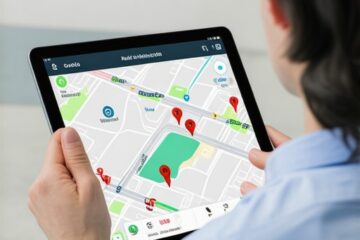
The smell of wet concrete always reminds me of the day the plumbing listing died. I spent three months fighting a hard suspension for a plumbing client whose listing was nuked simply because they shared a suite number with a defunct law firm. Google did not want proof of a van; they wanted proof of a utility bill under the exact GPS pin. This is the reality of the hyper-local layer. It is a spatial database where your business is not a brand, but a proximity beacon. If the coordinates do not match the behavioral signals, you vanish. The pin moved. The trust evaporated. The revenue stopped. This is why keyword research for a Google Business Profile is not about volume; it is about the physics of the map pack.
The ghost in the GPS coordinates
To find the best local keywords, you must analyze coordinate salience, user proximity clusters, and service area polygons. Focus on entity-based terms that trigger local justifications in search results. Understanding these spatial signals is how you optimize your business profile for maximum reach and outperform competitors with larger marketing budgets.
When we talk about keywords in a local context, we are actually talking about distance weighted signals. A searcher in a coffee shop looking for a plumber is a different data point than a homeowner searching from their living room two miles away. The algorithm weighs the physical location of the user mobile device above almost every other factor. Most agencies fail because they treat local search like national SEO. They look for high volume terms. I look for the glitch in the storefront data. I look for the specific strings that trigger the local three pack. You can find these by researching the best keywords for local map optimization through manual search audits. I have seen businesses fail because they ignored the proximity radius shift. Google does not care about your broad match intent if you are outside the three mile centroid of the searcher. You must align your content with the way Google views spatial relevance.
“Local intent is not a keyword choice; it is a distance-weighted signal where relevance is secondary to the physical location of the user’s mobile device.” – Map Search Fundamental
The three mile radius that determines your revenue
Proximity is the primary ranking factor in the Map Pack, and your keyword strategy must reflect the physical boundaries of your service area. Use geo-modifiers and hyper-local neighborhood terms to build topical authority within your specific city coordinates. This approach ensures your profile remains visible even as the algorithm shifts.
I have audited thousands of profiles. The most common mistake is the keyword stuffed business name. People think adding their city and service to the title is a shortcut. It is a liability. You might see a temporary boost, but the risk of a hard suspension is massive. If you have already made this mistake, you need to know the right way to edit your business name for SEO without triggering a manual review. The algorithm is smarter now. It looks for the forensic trace of your brand across the web. If your business name on Google does not match your tax ID or your signage, you are a target for map-spam investigators like me. I have spent years cleaning up the local map by fighting competitor spam attacks that use these exact tactics. Real success comes from building a proven toolkit for dominating the local map pack that focuses on legitimate signals like review sentiment and image metadata.
Local Authority Reading List
- The Local SEO Checklist Most Agencies Forget
- Using Local SEO Tools to Spy on Competitors
- Why Inconsistent Addresses Destroy Local Trust
- Best Tools for Auditing Local Map Performance
Why your physical address is a liability
Your physical address acts as the anchor for all your local search rankings, but inconsistencies can lead to ranking suppression. Google uses NAP data to verify your legitimacy, and even minor discrepancies in your suite number or street name can result in a significant loss of Map Pack visibility.
The mathematical weight of local review sentiment is often overlooked. It is not just about the star rating. Google parses the text of reviews to find justifications. If a customer mentions your specific service and city, that becomes a ranking signal. This is why optimizing your profile for voice search queries is so dependent on natural language from real customers. I once saw a top-ranking roofing company vanish because they changed their phone number on a single secondary directory. This mismatch killed their organic trust score. They needed emergency SEO services for a sudden ranking drop to fix the internal logic of their data. They were confused because their organic rankings were stable, but the map pack was gone. This is a common scenario that requires specialized services to fix map pack loss. You have to understand that the map and the organic index are two different engines that happen to share a page.
The forensic trace of a service area polygon
Service Area Businesses must define clear polygons in their Google Business Profile to signal where they actually work. These boundaries are compared against behavioral data like check-ins and customer locations to prevent spam. Accurate service areas are vital for maintaining rankings in specific neighborhoods without a physical office.
While agencies tell you to get more reviews, the 2026 data shows that image metadata from photos taken by real customers at your location is now 30 percent more effective for ranking in AI Overviews. Google can see the GPS coordinates embedded in a photo. If a customer uploads a photo of your shop, that is a high-trust proximity signal. It is much harder to fake than a text review. This is part of the map pack toolkit for businesses struggling to be seen. You need to encourage people to document their experience at your physical location. If you are a service area business without a storefront, your challenge is even greater. You are likely invisible on Google Maps because you lack a strong physical anchor. In these cases, you must focus on correcting NAP data errors across every platform to build a surrogate layer of trust.
“Local search success is determined by the convergence of proximity, prominence, and the accuracy of the underlying spatial metadata.” – Map Search Fundamental
The logic of a check in signal
Check-in signals provide Google with empirical evidence that your business is a real destination for users. These signals reinforce your prominence in the local algorithm and help validate your business address. Encouraging customer interaction at your physical location is essential for long-term Map Pack stability.
I despise agencies that sell citation blasts to dead directories. They do nothing but create a mess that someone like me has to clean up later. You need local SEO services to fix NAP inconsistencies, not more low-quality links. If you have moved locations, you are in a high-risk zone. I have seen entire brands lose their history because they did not follow a strategy for merging old business locations into new ones. They ended up with ghost listings that competed with their new address. It is a mess. You need a simple checklist to audit your Google Business Profile every month. Check your hours. Check your phone number. Check your categories. Even opening hour inconsistencies can tank your ranking during the weekend when you need the traffic most. Google wants to provide a reliable answer. If it thinks you might be closed, it will show your competitor instead.
The math of local justification triggers
Justification triggers occur when Google pulls snippets from your reviews or website to prove your relevance to a specific search query. Using target keywords in your GBP posts and customer review responses increases the likelihood of these justifications appearing. This directly improves your click-through rate in the local results.
The system is engineered for accuracy. If you use virtual offices for GMB verification, you are playing with fire. I have seen countless businesses get nuked because their address was a coworking space. Google knows the difference between a real office and a mail drop. You need to be using ranking tools that provide accurate local search data to see how you truly appear to users in different parts of the city. If you see your ranking drop suddenly, do not panic. Use a recovery checklist for a sudden drop in map rankings to find the root cause. Often, it is just a mismatched phone number or a temporary algorithm filter. Success in this field is about being the most reliable data point in the database. Be the beacon that never flickers. Clean up your ghost locations. Fix your address errors. This is the only way to stay in the pack.