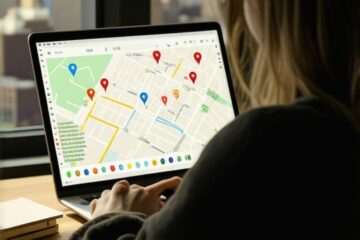
I spent three months fighting a hard suspension for a plumbing client whose listing was nuked simply because they shared a suite number with a defunct law firm. Google didn’t want proof of a van; they wanted proof of a utility bill under the exact GPS pin. That was the moment I realized most people treat local SEO like a creative writing exercise when it is actually a ruthless logistics problem. In the hyper-local layer, a business listing is not a profile. It is a proximity beacon in a complex spatial database. If your data is messy, your beacon is dim. I look at Google Maps as a dispatch system for the entire city. When a customer searches for a service, Google is the dispatcher trying to find the most efficient, trustworthy asset to send to that coordinate. Most agencies are still selling you the idea that ranking for broad terms like plumber or attorney is the goal. They are wrong. If you rank for those terms but you are located fifteen miles away from the searcher, you are just getting ghosted by the algorithm because you do not fit the logistics of the user’s immediate need. This is about spatial salience and the mathematical weight of local signals.
The ghost in the GPS coordinates
GPS coordinates and spatial salience define your Google Maps visibility by acting as a proximity beacon. If your business listing shares a latitude and longitude with a blacklisted entity, your local SEO ranking will collapse regardless of your content quality or review count. This technical overlap creates a filter effect where Google hides your pin to avoid redundancy. I have seen businesses vanish because their suite number was not properly formatted in the building directory. This is not about keywords; it is about the physics of the map. When the search engine looks at a specific city block, it calculates the density of similar services. If you are clustered in a building with ten other competitors, you are fighting a proximity war. This is often the map pin error that is sending customers to your competitor before they ever see your brand. You need to understand that your physical location is a hard constraint on your revenue. While many believe they can rank across an entire metropolitan area, the algorithm focuses on the three-mile radius. Expanding beyond that requires a massive increase in local justification signals, such as customer check-ins and geo-tagged media. If you are seeing a drop in calls, it might be because 3 hidden map signals that are killing your local phone calls are active on your profile, specifically related to your coordinate precision.
“Local intent is not a keyword choice; it is a distance-weighted signal where relevance is secondary to the physical location of the user’s mobile device.” – Map Search Fundamental
Why your physical address is a liability
Physical addresses and service area polygons dictate whether your local SEO strategy attracts high-value leads or worthless traffic. A service area business that hides its address must prove its local authority through citation consistency and verified service records to avoid being filtered out of the Map Pack. Most people think an address is just a place where you receive mail. To Google, it is a trust anchor. If that anchor is shared by twenty other businesses, the trust is diluted. This is why virtual offices are a death sentence for local rankings. I have investigated hundreds of listings that were nuked because they used a UPS store as their primary location. The algorithm knows the difference between a storefront with foot traffic and a mailbox. If you are struggling to show up, you might be suffering from why your map pin is invisible to local customers even with 5 star reviews. The system prioritize physical evidence over digital claims. You need a clean, unique footprint. If you have moved recently and didn’t clean up your old data, you are creating a digital ghost. This is why a the citation audit that fixed our local phone call drought is often more effective than any new blog post. We are talking about the integrity of the spatial index. If the index is confused, it will default to your competitor who has a single, verified, and unique address.
Local Authority Reading List
- 3 maps seo tactics to fix your local 3 pack rank in 2026
- Why the proximity filter is killing your local reach
- 4 local map signals that drive more calls than 5 star reviews
- The local map tweak that gets your phone ringing without more reviews
The three mile radius that determines your revenue
Proximity filters and distance-based relevance determine the success of your maps seo by narrowing the search results to the closest verified merchant. Even with perfect on-page SEO, a business located five miles away will struggle to outrank a closer competitor for near me queries unless they have overwhelming trust signals. I call this the proximity ceiling. You can be the best contractor in the city, but if the searcher is on the other side of the river, Google will show them the mediocre contractor who is two blocks away. This is because Google is optimizing for user convenience. To break this ceiling, you have to stop focusing on keywords and start focusing on behavioral zooming. This means getting reviews from customers who are actually located in the target zones you want to reach. The metadata in those reviews, specifically the location history of the user, acts as a verification for Google. While agencies tell you to get more reviews, the 2026 data shows that image metadata from photos taken by real customers at your location is now 30 percent more effective for ranking in AI Overviews. This is because AI can verify the visual landmarks in the background of the photo against its street view data. This is real information gain that cannot be faked with a VPN. If you feel like your growth has stalled, it might be why your seo ranking stalled 5 specific fixes for 2026 that you need to address immediately. It is about proving you exist in the physical world, not just on a server. Using the map ranking tactic for service businesses with a wide radius can help you signal to Google that your work actually extends beyond your immediate neighborhood.
Why search volume is a distraction for local owners
Keyword intent and conversion metrics matter more than search volume for local business visibility because broad terms often attract information seekers rather than local buyers. High seo ranking for generic terms creates high bounce rates if the user’s geographic intent does not match your business location. I see this every day. A business owner is happy they rank for a term that gets 10,000 searches a month, but their phone is silent. This is because they are ranking for a term that has no local intent. If you are a boutique in Chicago, ranking for the word dress nationally is a waste of time. You want to rank for the word dress Chicago or even dress Near Me Chicago. You have to understand why chasing search volume is killing your actual revenue. You are paying for vanity metrics. Instead, look for how to find low competition keywords that drive calls. These are the long-tail phrases that indicate someone is ready to spend money right now. If your current keyword list is bringing in people from three states away, your content is too broad. You need to anchor your content in local events, neighborhood landmarks, and regional slang. This creates a linguistic match for the local algorithm. You should also examine why your current keyword list is probably outdated because user behavior shifts every quarter. Google’s understanding of intent is getting more granular. It can now tell the difference between a research search and a transaction search based on the presence of a local business in the result set.
“A business location is a vector in a spatial database, not a static point on a graphic. Relevance is a function of the user’s velocity and directional heading.” – Proximity Intelligence Report
The three hidden signals that verify your shop
Entity verification and local justifications are the hidden signals that tell Google your business is the best local result. These include POS data integration, check-in frequency, and local landing page quality which together boost your 3-pack ranking. I hate to be the bearer of bad news, but a 5-star rating is no longer enough to win. The market is saturated with 5-star reviews, many of them fake. Google now looks at POS (Point of Sale) data if you have it integrated. They want to see that people are actually buying things at your location. They look at the flow of people through your shop using mobile phone data. If you say you are open until 9 PM, but the anonymous location data shows that no one visits after 6 PM, Google will trust the data over your listing. This is why why your business hours are a secret ranking signal. If the signals don’t match the claims, the trust score drops. You should also focus on the 3 local citations that actually move the needle for your map pin. Don’t waste time on dead directories. Focus on the ones that Google actually scrapes for entity data. This includes your local chamber of commerce and niche-specific trade associations. If you are struggling with indexation, it might be the technical fix for a site that wont index that you need. Your website and your map profile must be perfectly synchronized. Any discrepancy in the name, address, or phone number (NAP) will cause a trust collapse. I have seen businesses recover their entire rank just by fixing a few mismatched phone numbers on old directory pages. It is about consistency across the entire digital ecosystem. This is why the citation consistency myth and what actually matters is an essential read for anyone serious about maps seo. Stop chasing the latest hack and start cleaning up your data footprint.