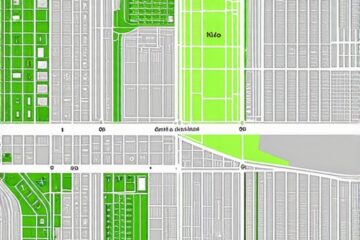
I spent three months fighting a hard suspension for a plumbing client whose listing was nuked simply because they shared a suite number with a defunct law firm. Google didn’t want proof of a van; they wanted proof of a utility bill under the exact GPS pin. This incident taught me that the local algorithm does not care about your brand story as much as it cares about the cold, hard physics of your physical location. When you walk through a city, you smell the wet concrete and the exhaust of service vans, but the algorithm only sees a lattice of coordinates. If your business exists outside the high-density commercial core, you are fighting a mathematical headwind that most agencies do not understand. The map pin is not a static marker; it is a proximity beacon that fluctuates based on the user’s current latitude and longitude.
The invisible wall of the city center centroid
The city center centroid acts as the primary anchor for local search relevance because Google assumes the highest density of commercial activity exists at the geographic heart of a municipality. When you move away, the proximity signal weakens significantly, causing your Map Pack visibility to vanish. The algorithm uses a distance-weighted filter that prioritizes the nearest relevant result to the user. This is why a search for a locksmith in the suburbs yields different results than one conducted in the downtown district. You can see this clearly when you how to handle a proximity based ranking drop after a major update. The system calculates the distance between the user and the verified business address. If that distance exceeds a specific threshold, your prominence score must be exceptionally high to compensate. Most businesses fail because their prominence does not scale with their distance from the center. You must treat your location as a data point in a spatial database, not just a place where you work. The glitch in the storefront data often stems from a misunderstanding of how these coordinates are registered. When the pin is off by even a few meters, the entire proximity loop breaks.
Why your physical address is a liability
A physical address becomes a liability when it is located in a saturated market or too far from the high-intent search clusters where your customers actually live and work. Google evaluates the physical distance of your office from the average searcher to determine if you are a viable option. Many owners think that having a prestigious downtown office is the only way to win. However, if your service area covers the entire metro, being stuck in the center might actually hurt you in the outskirts. I have seen companies struggle with the technical reason your map pin is stuck in the same spot despite moving their operations. This happens because the old data remains in the aggregator ecosystem. You have to scrub the local directories to ensure the old signal is dead. If you do not, Google sees conflicting information and lowers your trust score. This lack of trust leads to a lower rank in the Map Pack. You can find more about this by auditing your online business info for local search success regularly. The process is manual and exhausting, but it is the only way to fix a broken proximity signal. You cannot hide from the GPS math.
“Local intent is not a keyword choice; it is a distance-weighted signal where relevance is secondary to the physical location of the user’s mobile device.” – Map Search Fundamental
The three mile radius that determines your revenue
Revenue in the local ecosystem is often dictated by a narrow three mile radius where your business appears in the top three map results. Beyond this circle, your impressions drop by as much as eighty percent as the proximity filter kicks in and highlights closer competitors. This is the reality of the Vicinity update. It prioritized distance over almost every other factor. If you are a service business, you might notice that boosting impressions for service area businesses on maps requires more than just a wide service polygon. You need localized reviews and geo-tagged photos. The Street Photographer in me knows that a candid photo of your van in a suburban driveway is worth more than a stock photo of a smiling technician. Google uses the metadata from those images to verify you were actually there. This creates a forensic trace of your activity. If all your activity is centered downtown, you will never rank in the suburbs. You must move your behavioral signals to the areas where you want to win. This means getting reviews from customers in those specific zip codes.
Mathematical weight of local review sentiment
Review sentiment carries heavy mathematical weight because Google uses natural language processing to extract entities and local justifications from customer feedback. When a reviewer mentions a specific neighborhood or landmark, it reinforces your authority for that specific geographic area in the search index. If your reviews only mention the city name, you are missing out on hyper-local relevance. You need to encourage customers to mention their suburb or cross-streets. This is part of reputation management and review repair services that actually move the needle. A review that says the technician arrived on time in South Ogden is infinitely more valuable than one that just says great service. It anchors your business to that location. Furthermore, the frequency of these mentions builds a map of your service reliability. If Google sees a cluster of reviews from a specific suburb, it will expand your proximity radius into that area. This is how you fight the city center pull. You are essentially building a new centroid based on customer proof rather than just your office lease.
Local Authority Reading List
- A Tactical Plan to Fight Back Against GMB Spam Attacks
- The Impact of GMB Category Selection on Local Rank
- How to Audit a Multi Location Site for Search Cannibalization
- Recovering Visibility After Fixing a Keyword Stuffed Name
- Why Your Business Name and Address Must be Perfectly Consistent
The forensic trace of a service area polygon
A service area polygon serves as a digital boundary that tells Google where you are willing to travel, but it does not guarantee ranking within that entire zone. Google still prioritizes the physical verified location over the declared service area when calculating proximity for competitive keywords. Many businesses think setting a fifty-mile radius will help them. It won’t. In fact, it can sometimes dilute your relevance if you don’t have the data to back it up. You should start by why hiding your business address might be hurting impressions if you are an SAB. Hiding the address removes the primary proximity pin. While Google allows it, it often results in a massive ranking drop outside your immediate neighborhood. The algorithm prefers transparency. It wants to know exactly where your van starts its day. If you want to rank in multiple zones, you need to prove you have a presence there. This involves using the proven toolkit for dominating the local map pack to analyze where your competitors are hiding. Often, they are using virtual offices, which is a violation of the rules. Reporting these spam listings is a legitimate strategy for reclaiming your territory.
The cost of a mismatched GPS signal
A mismatched GPS signal occurs when your website schema, your Google Business Profile, and third-party citations provide conflicting latitude and longitude data for your storefront. This confusion forces the algorithm to choose the most conservative proximity estimate, often resulting in a lower map position. You must ensure that your JSON-LD LocalBusiness attributes are precise. If your website says one thing and your GBP says another, the trust score collapses. I once saw a business lose its top spot because their website developer used a generic city center coordinate for the map embed while the actual office was three miles away. The algorithm saw the discrepancy and filtered the listing. You can avoid this by auditing your online business info for local search success and matching every character of your NAP (Name, Address, Phone). Beyond this, you need to look at the fix for mismatched phone numbers in local listings. A wrong phone number is a signal of a neglected business. Google hates neglected businesses. It wants to show users active, accurate results. The cost of a small error is the loss of high-intent phone calls.
“Proximity is the most powerful ranking factor in local search, often overriding relevance and prominence when a user is on the move.” – Location Intelligence Whitepaper
Fixing GMB issues caused by virtual office or coworking space
Virtual offices and coworking spaces often trigger immediate suspensions or ranking filters because they lack a dedicated entrance and permanent signage required by Google Business Profile guidelines. These shared spaces confuse the algorithm as multiple businesses attempt to verify the same geographic footprint. I have spent years fixing gmb profile issues linked to coworking spaces for clients who were sold a bad bill of goods by virtual office providers. You cannot just rent a mailbox and expect to rank in the Map Pack. You need a real physical presence. If you are currently in a coworking space, you must have photos of your permanent signage and your dedicated office door. Without this, you are one report away from a permanent ban. If you have been banned, you might need local seo services to fix banned gmb listing protocols. This involves a formal appeal with utility bills and lease agreements. It is a grueling process that requires precision. The algorithm is designed to weed out these low-quality signals. If you want to stay in the game, you have to follow the rules of the spatial database.
The strategy for managing ten locations in one city
Managing ten locations in one city requires a strict avoidance of search cannibalization where your own listings compete against each other for the same proximity signals. Each location must have a unique physical address and a distinct service area to maximize the total geographic coverage. If you put two offices too close together, Google will filter one of them out. This is the proximity filter at work. You can learn more about the strategy for managing ten locations in one city to ensure each branch has its own breathing room. Each location needs its own landing page on your website with unique content and local testimonials. Do not use a template. Each page must reflect the specific neighborhood it serves. You also need to how to audit a multi location site for search cannibalization to see if your internal links are pointing to the wrong branch for specific keywords. If your North office is ranking for South office keywords, your data is messy. You need to clean it up to regain control of the map results. The flow of data must be logical and consistent across the entire web.