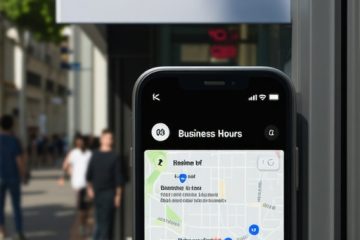
The sidewalk smells like wet concrete and the air carries a sharp metallic tang from the nearby train tracks. I am standing outside a storefront where the neon sign flickers with a rhythmic buzz. To the average passerby, this is just a dry cleaner. To me, it is a data point struggling for oxygen in a congested spatial database. I see the glitches in the digital storefront that most business owners ignore. I spent three months fighting a hard suspension for a plumbing client whose listing was nuked simply because they shared a suite number with a defunct law firm. Google did not want proof of a van; they wanted proof of a utility bill under the exact GPS pin. That experience taught me that the map is a battlefield of invisible filters. Your choice of a business category is not just a label. It is a proximity beacon that can either signal your relevance or trigger a filter that makes you invisible to everyone more than a mile away.
The invisible barrier of category duplication
Primary business categories create a digital boundary that can hide your listing if you share a category with closer competitors. Google algorithms prioritize diversity in the Map Pack, meaning two identical businesses in the same building often see one filtered out of visibility to improve the user experience. This is why proximity filter killing your reach is a reality for many. If you and your neighbor both choose Personal Injury Attorney, Google will likely pick the one with the strongest historical behavioral signals and suppress the other. You might need the 3 step audit for a map pin to understand why you are the one being hidden. The algorithm looks for the most prominent entity in a specific category within a specific radius. When the density of that category reaches a certain threshold, the filter tightens. I have seen businesses disappear because they were one of ten identical categories on a single block. They were not penalized. They were simply redundant in the eyes of the machine. This is why choosing a sub-category that is less congested can often trigger a wider visibility radius. You are effectively moving into a less crowded room where your voice carries further.
The ghost in the GPS coordinates
GPS coordinate salience determines the centroid of relevance for your business. If your latitude and longitude are clustered with other businesses in the same category, Google might filter your listing to avoid search result duplication. The mathematical weight of your location is calculated against every other competing pin. I often use a gmb ranking toolkit to visualize these shifts. When you hide your address, you are telling Google to rely on your service area polygon, but the system still anchors your trust score to a physical verification point. If that point is shared, the trust score splits. I have worked with businesses that needed seo services to remove google manual action because they tried to game this system with virtual offices. The algorithm now uses street view imagery and third party data to verify that your signage actually exists. If the visual data does not match the category claim, you get a soft suspension or a total ranking collapse. It is a forensic trace that starts at the curb and ends in the database.
“Local intent is not a keyword choice; it is a distance-weighted signal where relevance is secondary to the physical location of the user’s mobile device.” – Map Search Fundamental
The three mile radius that determines your revenue
Proximity weighting remains the most powerful force in the Map Pack ecosystem. Even if you have the best reviews, a competitor located 500 feet closer to the user will often outrank you for high intent searches. This is why you need to understand why competitors with fewer reviews outrank you. The algorithm calculates the travel time and the likelihood of a visit based on mobile movement data. If your category is too broad, you are competing against every business in that radius. If you refine your category, you might find a pocket of the city where you are the only relevant result. I once saw a locksmith double their call volume just by switching their primary category to a more specific niche that matched their actual work. They were using the keyword audit that proved wrong audience targeting to realize their mistake. The local search engine is not a phone book; it is a dispatch system. It wants to provide the most convenient, reliable solution. If your category data is messy, the machine views you as a risk. It would rather show a closer, mediocre business than a distant, excellent one.
How to fix a disappearing map pin
Map pin visibility is restored by cleaning up NAP consistency and removing duplicate business categories that confuse the crawler. You must audit your secondary categories to ensure they do not conflict with your primary mission. Many owners think more categories equal more reach. The opposite is often true. Over-categorization can dilute your relevance for your main service. Use the 5 minute fix for messy schema markup to clarify your identity to the bots. You should also look for citation mistakes that kill your ranking. A single mismatched phone number on an old directory can be enough for Google to lose trust in your location. I have seen businesses recover after using seo services to recover impressions after hiding business address. The fix is often technical. You need to align your website content with your GMB attributes. If your site talks about plumbing but your GMB category is set to General Contractor, you are creating a cognitive dissonance for the algorithm. It will hedge its bets by ranking someone more consistent.
“The Vicinity update shifted the weight of local rankings toward absolute proximity, effectively nerfing the advantage of keyword-rich business names in favor of physical distance.” – Local Intelligence Report
Shadows in the storefront data
Behavioral signals such as click-to-call rates and driving direction requests provide the final layer of proof for your business category. Google monitors how users interact with your listing. If people search for a bakery and click on your listing, but immediately bounce because you are actually a cafe, the algorithm learns. It will adjust your visibility. This is why traffic is high but calls are low in some cases. You are being shown for the wrong things. You might need seo services to fix keyword stuffing and content issues if your site is attracting the wrong local intent. I look at the small details. I check the metadata of the photos your customers upload. If they are taking photos of coffee but your category says Bookstore, the AI notices. It sees the mismatch between the visual reality of the storefront and the digital claim of the listing. To win in 2025, you need to align every signal. The scent of the wet concrete, the flickering sign, and the JSON-LD on your server must all tell the same story. If they don’t, you are just a ghost on the map.